Metal Cladding Colours: The Complete UK Guide
Metal Cladding Colours: The Complete UK Guide to Finishes, RAL Colours & Combinations
Choosing the colour of your metal cladding is one of the few decisions in a building project you will live with — and look at — every day for decades. Get it right and your home, extension or commercial building gains kerb appeal, passes planning smoothly and holds its finish for 25 years or more. Get it wrong and you are staring at a faded, chalky facade that cost a fortune and pleases no one.
This guide covers everything UK homeowners, architects and developers need to know about metal cladding colours: how the RAL system works, which colours lead in 2026, how PVDF and polyester coatings compare, and which metal cladding colour combinations actually work on real British buildings. (And yes — plenty of people search for “metal cladding colors”; same finishes, different spelling.) As metal cladding specialists working across London, Essex, Hertfordshire, Oxford and Cambridge, we install these finishes every week — so this is practical, site-tested advice, not brochure copy.
Why Colour Choice Matters More Than You Think
Colour is not just cosmetic on a metal facade. It affects four practical things:
Kerb appeal and property value. The facade is the first thing anyone sees. A well-chosen standing seam colour — anthracite zinc against warm brick, for example — reads as considered architecture; a jarring one reads as an afterthought.
Planning permission. In conservation areas and on sensitive sites, planners routinely favour natural and patinated metal tones — weathered zinc grey, patina green copper, muted bronzes — over bright or glossy colours. Choosing a planning-friendly palette early can save weeks of back-and-forth.
Heat performance. Dark colours absorb more solar heat because of their low solar reflectance; light colours can reduce heat gain by around 30%. On a south-facing facade or a well-insulated modern extension, that difference is real.
Maintenance and longevity. A premium PVDF finish holds colour and gloss for 20–25+ years; a standard polyester powder coat manages 10–15 years, and dark colours may chalk in as little as 5–7 in high-UV positions. The colour you pick and the coating you pick are the same decision.
The RAL Colour System Explained
Almost every coated metal cladding product in the UK is specified by RAL number, so it pays to understand the basics. (Our companion metal cladding colours guide covers palettes by property type in more depth.)
RAL Classic is the original system: 213 standard colours, each with a four-digit code — the codes quoted by most fabricators, such as RAL 7016 and RAL 9005.
RAL Design is the extended system used mainly by architects, with more than 1,600 precisely defined shades.
Two practical tips. First, always view physical samples outdoors — a colour on a screen can look dramatically different on a north-facing elevation in November. Second, the same RAL colour reads differently at different gloss levels: RAL 7016 in matt feels softer and more architectural than the same code in gloss.
The Most Popular UK Metal Cladding Colours in 2026
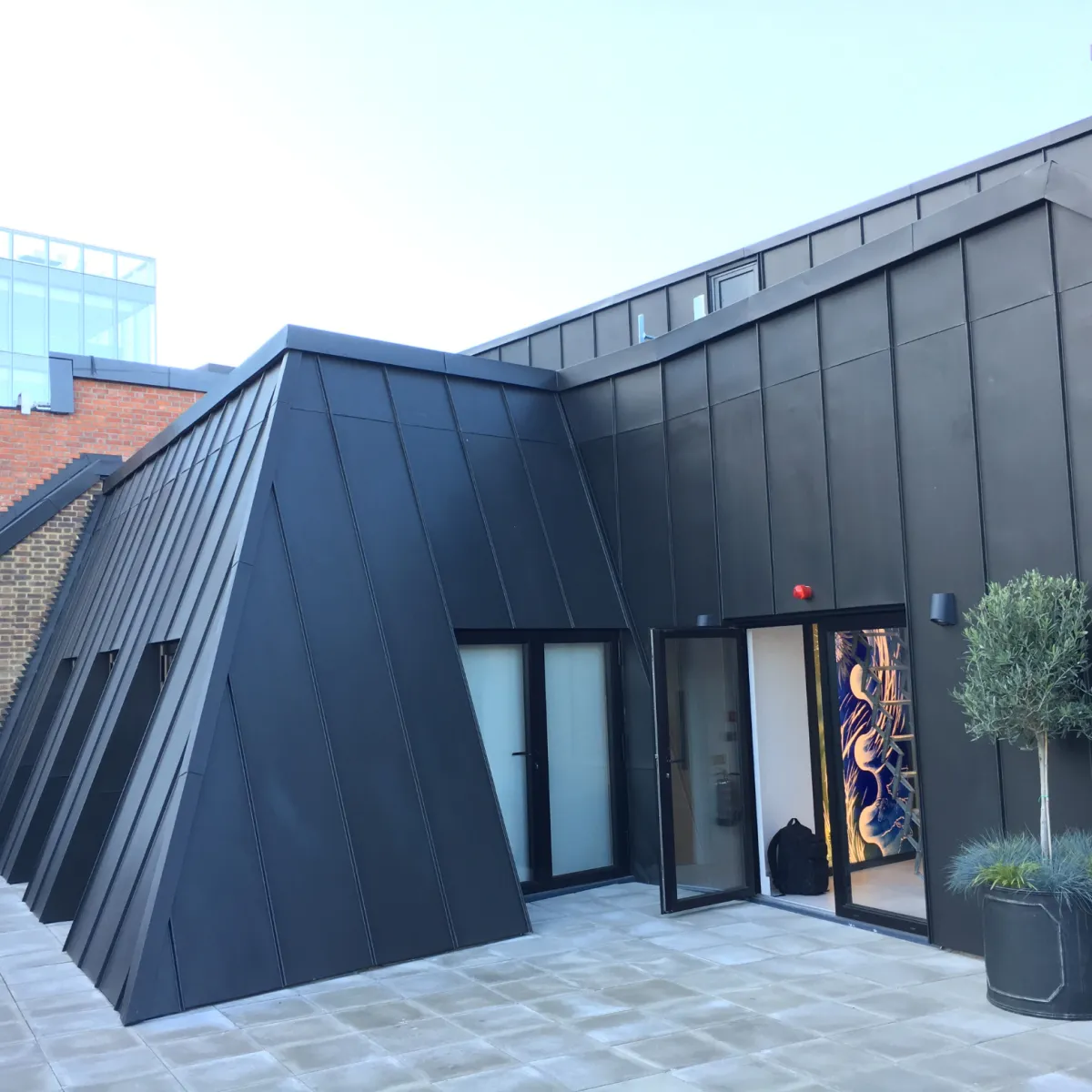
RAL 7016 Anthracite Grey remains the most specified grey in UK metalwork, and for good reason: it is dark enough to feel contemporary, neutral enough to sit alongside brick, render and timber, and forgiving of urban grime. Across London and the Essex commuter belt, the anthracite standing seam extension is practically a genre of its own.
Close behind are the true darks: RAL 9005 Jet Black and RAL 7021 Black Grey, giving a sharper, more monolithic look — popular on garden rooms, dormers and minimalist new-builds.
The notable trend for 2025/26 is a softening of the palette, with growing demand for softer warm greys (shades like Agate and Pebble) and earthy bronze tones that bridge contemporary metal and traditional materials.
Then there are the metals that colour themselves. Pre-weathered zinc arrives with its patina already formed — VMZINC’s QUARTZ-ZINC and ANTHRA-ZINC, Rheinzink’s prePATINA blue-grey and graphite — while copper moves from bright metallic brown through dark bronze to its famous green patina. For conservation-area projects, these living finishes are often exactly what planners want to see.
Finish Types Compared: PVDF vs Polyester vs Pre-Weathered Metals
The colour is only as good as the coating that carries it. Here is how the options compare.
PVDF (e.g. Kynar 500)
The premium painted finish. PVDF coatings hold colour and gloss for 20–25+ years, resist UV chalking and are near-essential in coastal settings where salt air attacks lesser finishes. Available across the full RAL range, PVDF is the default for long-life aluminium cladding.
Polyester powder coating
The budget-friendly option, typically lasting 10–15 years. Serviceable for sheltered elevations, but dark colours may chalk in 5–7 years in high-UV positions. Fine for a garden studio; less ideal for a south-facing facade.
Pre-weathered zinc cladding colours
Zinc does not need paint — its colour is its patina. Pre-weathered ranges such as VMZINC QUARTZ-ZINC and ANTHRA-ZINC, or Rheinzink prePATINA in blue-grey and graphite, deliver a consistent, mature finish from day one. For colour beyond greys, VMZINC’s PIGMENTO range adds red, blue, green and brown pigments while keeping the natural zinc texture, and elZinc offers its own coloured ranges. Pre-weathered finishes typically add around 12–15% over mill finish.
Coated steel
Modern coated steels have moved on enormously. GreenCoat PLX uses a bio-based coating and carries a 50-year technical and 25-year aesthetic warranty, in colours including Anthracite Grey, Nordic Night Black and metallic Dark Silver and Copper. For a robust facade with serious warranty backing, GreenCoat steel cladding is hard to beat, and our wider steel cladding range covers everything from standing seam to flat-lock panels.
Coil-coated aluminium
PREFA’s P.10 coil-coated aluminium finishes carry a 40-year material and colour guarantee across around 20 colours, including anthracite (approximately RAL 7016), black, bronze and patina green. Lightweight and corrosion-proof — see our traditional texture aluminium cladding page.
Stainless steel
For a maintenance-free metallic finish, Uginox stainless steel offers a subtle, self-healing surface in natural and darkened tones — explore our Uginox stainless steel cladding work.
Not sure which finish suits your project? Dr Master Craft offers a free colour consultation with physical samples you can view against your brickwork, render or timber — in daylight, where it matters. Book yours here.
Metal Cladding Colour Combinations That Work
The best facades rarely rely on one material. Here are combinations we see succeed on UK projects:
Anthracite + timber. RAL 7016 standing seam with cedar or larch accents is the modern British extension signature — warm wood stops the dark metal feeling cold.
Bronze + brick. Bronze-finish aluminium or weathering-toned copper against London stock or red brick feels both contemporary and rooted — a strong choice for rear extensions in period streets.
Patina green copper + render. Pre-patinated or naturally weathering copper cladding above clean white render gives a crisp contrast that planners in conservation areas tend to welcome.
Zinc blue-grey + flint or stone. Rheinzink’s prePATINA blue-grey sits beautifully with flint and stone — a favourite on rural projects in Oxfordshire and the Cambridgeshire villages.
Black + glass. RAL 9005 or Nordic Night Black steel with large-format glazing delivers the sharp, minimal look popular on contemporary new-builds. For more inspiration, see our piece on cladding and roofing ideas.
How to Choose: Samples, Planning Context and Warranties
A five-step approach we use with every client:
1.Start with context. Look at surrounding materials — brick tones, roof colours, neighbouring facades — and check whether you are in a conservation area.
2.Shortlist by metal first, colour second. Zinc, copper, aluminium and steel each have their own finishes, price points and patinas. Our products we use page compares the brands we install, including VMZINC, Rheinzink and elZinc.
3.View physical samples outdoors, in morning and afternoon light. Never choose from a screen.
4.Check the warranty behind the colour. PVDF systems, GreenCoat’s 25-year aesthetic warranty and PREFA’s 40-year colour guarantee all mean different things — know which you are getting.
5.Think about the whole envelope. The cladding colour should work with your roofing, windows and gutters — a good metal cladding contractor will coordinate all of it.
Why Use a Specialist Installer
Even the finest finish fails if it is detailed badly. Colour matching between panels, scratch-free fixing of coated metals, oil-canning control on dark flat panels, and cladding-to-roofing junctions are all specialist skills. As dedicated metal cladding specialists, we install zinc, copper, aluminium and steel systems to manufacturer specification — which is what keeps those long colour warranties valid.
If you are comparing cladding contractors in London and the surrounding counties, ask one simple question: which finish systems are you approved to install, and can I see samples? The answer will tell you a great deal. Learn more about our full cladding service.
Conclusion
Metal cladding colour is where design, physics and planning meet. The RAL system gives you precision, coatings like PVDF and GreenCoat give you longevity measured in decades, and the 2026 palette — from ever-reliable anthracite grey to warm bronzes and pre-weathered zincs — offers options for every British building. View real samples, match the finish to the setting, and choose a coating with a warranty to back it.
Ready to find your perfect colour? Book a free, no-obligation colour consultation with Dr Master Craft. We will bring physical samples of zinc, copper, aluminium and steel finishes to your property, talk through RAL options and planning considerations, and provide a clear written quote. For metal cladding in London, Essex, Hertfordshire, Oxford or Cambridge — contact our team today.