Zinc Cladding Cost per m² UK 2026: Real Prices | Dr Master Craft
How Much Does Zinc Cladding Cost per m²? UK Prices, Real Project Figures & What Drives the Quote
Zinc wall cladding typically costs £250–£350 per m² supplied and installed in the UK, with Checkatrade's 2026 national guide putting the average at £325 per m² including labour. Simpler standing seam work on large, flat elevations can come in lower; small, highly detailed or curved projects price higher. Spread over zinc's proven 80–100+ year lifespan, that works out at roughly £3 per m² per year — cheaper than almost every "budget" alternative once replacements and maintenance are counted.
If you're collecting quotes for a zinc-clad extension, dormer or feature wall, this guide gives you the honest numbers: the per-m² bands by system and finish, why two quotes for the same wall can differ by £100/m², what's often missing from cheap quotes, and when zinc earns its premium over timber, fibre cement and aluminium.
System / finish | Typical installed cost (UK, 2026) |
|---|---|
Zinc standing seam wall cladding | £250–£320 per m² |
Zinc flatlock / interlocking panel cladding | £280–£350 per m² |
Zinc shingles / bespoke patterns | £300–£400 per m² |
Premium finishes (VMZINC Pigmento, Anthra-Zinc+) | +£20–£50 per m² over standard finishes |
For comparison: copper cladding | £300–£450 per m² |
For comparison: aluminium panels | £200–£230 per m² |
For comparison: cedar timber | £150–£180 per m² |
For comparison: uPVC / fibre cement (Cedral) | £60–£100 per m² |
Indicative ranges for fully supported, ventilated build-ups including labour. Comparator figures from Checkatrade's 2026 UK cladding cost guide.
On real projects, that translates to roughly:
Single-storey extension wall (20–30 m²): £6,000–£10,000
Two-storey extension elevation (35–55 m²): £10,000–£17,000
Full house re-clad (80–120 m²): £22,000–£38,000
Scaffolding is usually quoted separately: £600–£1,200 for a single-storey elevation, £900–£1,800 for two storeys, £2,500–£5,000 for full-house access.
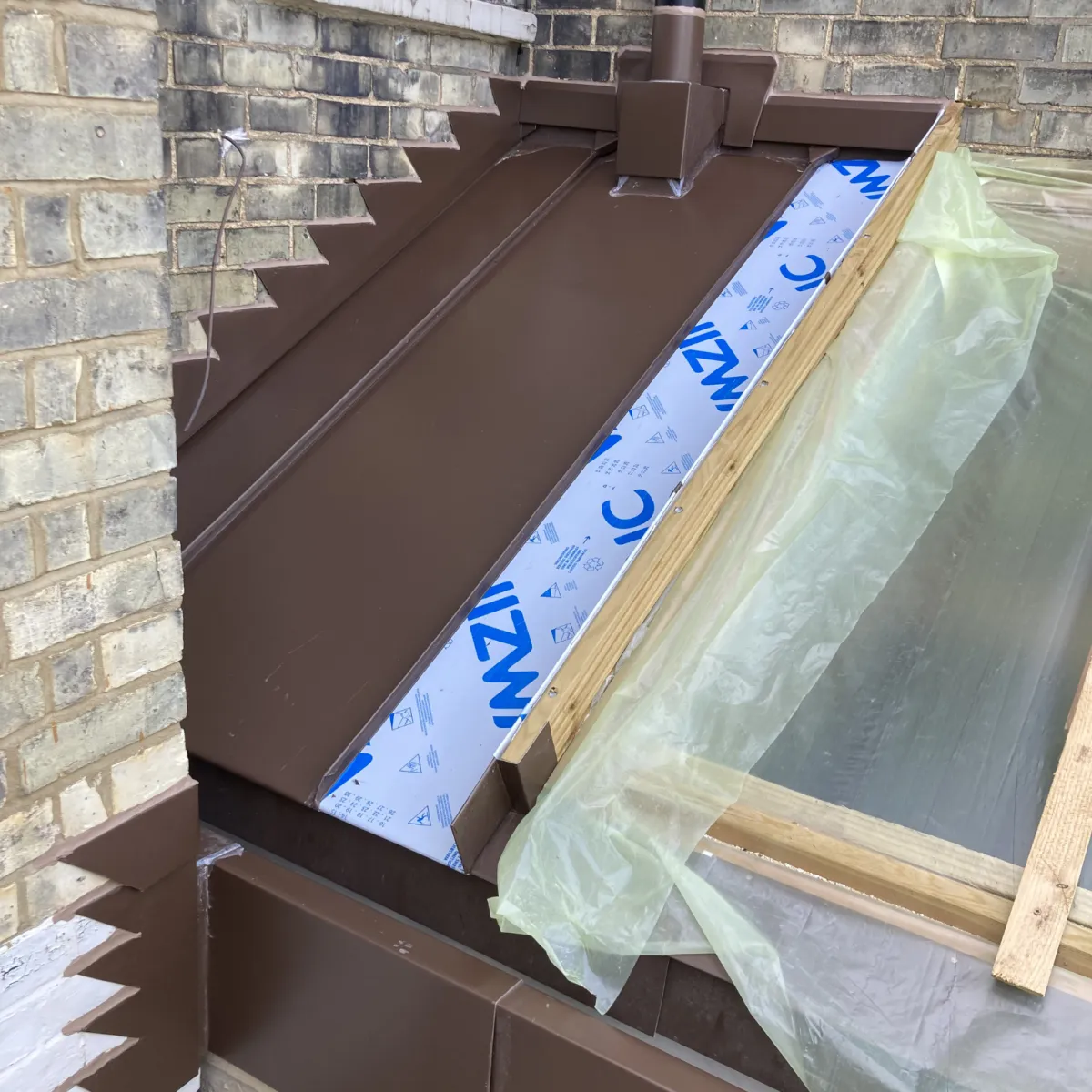
[IMAGE: zinc standing seam wall cladding on a rear extension]
Why quotes for the same wall can differ by £100 per m²
This is the most important section in this article. Zinc cladding quotes are not comparable until you know what's inside them. A £180/m² quote and a £320/m² quote for the same elevation are usually different products:
1. The build-up. A proper zinc rainscreen includes substrate or sheathing board, breathable membrane, ventilated cavity with counter-battens, and the metal itself. A cheap quote often assumes "fix to existing battens" — the detail responsible for most premature zinc failures, because trapped moisture corrodes the panels from behind. Ask every bidder to state the full build-up in writing.
2. Panel format and layout. Long standing seam trays on a big flat wall are the fastest, cheapest option. Flatlock panels, narrow reveals, small shingles and diagonal or herringbone layouts all add fabrication and fixing time. Panel widths set out to align with window heads and corners take design time before a single panel is cut.
3. Material thickness and brand. UK architectural zinc is typically 0.7–0.8 mm. VMZINC, elZinc and Rheinzink carry brand pricing; premium finishes like VMZINC Pigmento (the through-coloured range) sit above standard QUARTZ or ANTHRA finishes.
4. Detailing density. Every window reveal, corner, parapet, sill and junction is hand-formed. A wall with six openings costs meaningfully more per m² than a blank gable of the same area.
5. Size and access. Mobilisation, set-up and detailing are fixed costs — a 25 m² feature wall costs proportionally more per m² than a 150 m² elevation. Height and scaffold duration do the same.
6. Location. London and the South East carry a 25–35% labour premium over Midlands and Northern rates.
What the raw material actually costs
Zinc's price story is very different from copper's right now — and it's worth knowing as a buyer. LME zinc traded around $3,500–3,600 per tonne through mid-2026 — roughly a quarter of copper's price per tonne. A square metre of 0.7 mm zinc contains about 5 kg of metal, so the raw material value is only around £13–£15 per m².
Translation: with zinc, you're mostly paying for skilled fabrication, the ventilated build-up and detailing — not the commodity. That's also why the gap between a good installer and a cheap one matters more with zinc than almost anything else on a building. The metal is genuinely capable of 100 years; whether it delivers that depends almost entirely on who fits it. (The corrosion science behind the 100-year figure — 2 microns per year against a 700-micron sheet — is laid out in our guide to how long a zinc roof lasts.)
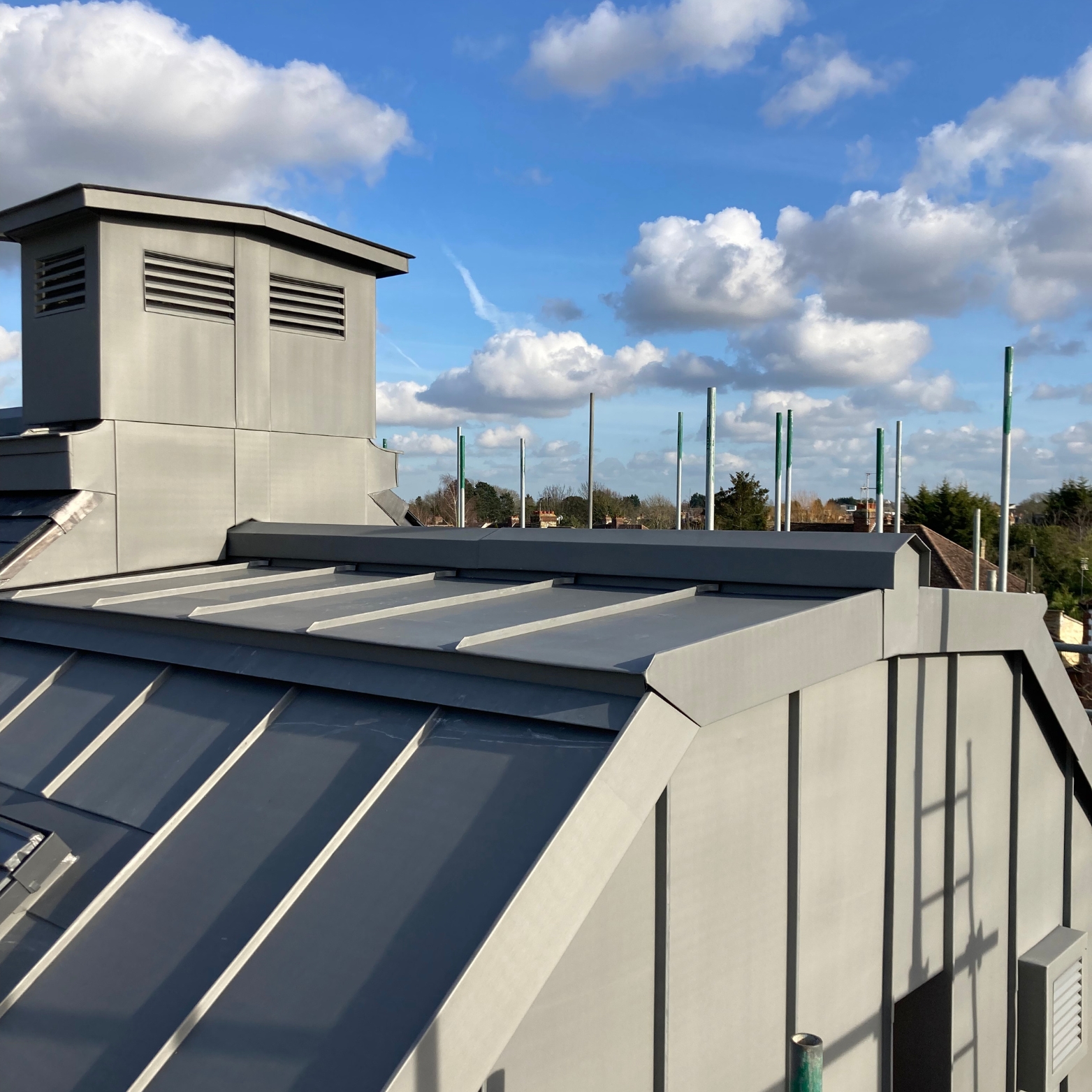
[IMAGE: installer closing standing seams on a zinc wall]
Zinc vs the alternatives: cost per year, not cost per m²
Per-m² prices flatter cheap materials. Here's the same comparison over a building's life:
Material | Installed cost | Typical service life | Maintenance cycle | Cost per m² per year |
|---|---|---|---|---|
Zinc | ~£300/m² | 80–100+ years | Gutters + occasional visual check | ~£3–3.50 |
Copper | ~£350/m² | 60–120+ years | Near zero | ~£3.50 (see copper cladding costs) |
Aluminium | ~£215/m² | 40–60 years | Near zero | ~£4–5 |
Cedar timber | ~£165/m² | 20–30 years | Re-treat every 2–5 years | ~£8–12 once retreatment and one replacement are counted |
uPVC / fibre cement | ~£80/m² | 20–30 years | Cleaning; fading/warping | ~£4–6 with two to three replacements |
Zinc is the value pick of the long-life metals: it delivers copper-class longevity for 10–30% less than copper, and its cost-per-year undercuts even "budget" claddings that need replacing two or three times in the same century. It's also fully recyclable at end of life — a genuine asset, not landfill.
How to keep the cost down without cheapening the job
Choose standing seam over complex formats on large flat areas; save flatlock or shingles for the feature elevation
Standard finishes (QUARTZ-ZINC, ANTHRA-ZINC) are beautiful — premium Pigmento colours are worth it where the facade is the architecture, not everywhere
Combine roof and walls in one contract — one scaffold period, one mobilisation, one coil batch (better colour consistency), and a single continuous weathering detail at the roof-wall junction
Get the design fixed before quoting — panel layouts locked early avoid re-fabrication on the scaffold
Compare scope, not headline rates — insist every quote states build-up, thickness, finish, clips and warranty
Get a real figure for your project
Every elevation is different, and the honest answer to "how much per m²?" is always a measured one. At Dr Master Craft we design, fabricate and install zinc cladding in standing seam, flatlock and bespoke formats using VMZINC systems with fully ventilated, breathable build-ups — and we itemise every quote so you can see exactly what you're paying for.
Send us your drawings or a few photos of the elevation and we'll come back with a considered quotation — usually within 48 hours.
→ Explore our zinc roofing & cladding service→ Request your free quote — 48-hour turnaround
Areas we cover
We install zinc, copper, aluminium and coated-steel cladding across London and the South East, including:
London — North London, Central and Prime Central London (Belgravia, Mayfair), South East London and all surrounding boroughs
Essex — including Chelmsford, Epping and the London fringe
Hertfordshire — St Albans, Hertford, Watford and surrounds
Surrey — Guildford, Woking, Epsom, Reigate
Kent — Sevenoaks, Tunbridge Wells, Maidstone, Canterbury
Oxfordshire — Oxford and the county
Cambridge, Brighton and the wider South East, with projects also undertaken further afield (including Exeter and the South West) for the right brief
Not sure if we cover you? Ask us — for distinctive projects we regularly travel beyond our core area.
Frequently asked questions
How much does zinc cladding cost per m² in the UK?Typically £250–£350 per m² supplied and installed, depending on system, finish, detailing and location. Checkatrade's 2026 guide puts the national average at £325 per m² including labour. Standing seam on large flat elevations sits at the lower end; shingles, complex layouts and premium Pigmento finishes sit at the top.
Is zinc cladding cheaper than copper?Yes — typically 10–30% cheaper installed. Raw zinc currently trades at roughly a quarter of copper's commodity price (~$3,550/t vs ~$13,600/t on the LME in 2026), and both metals deliver 80–100+ year lifespans. Copper carries the prestige aesthetic; zinc is the value pick of the long-life metals.
Why is one zinc cladding quote so much cheaper than another?Almost always scope, not generosity. Check whether each quote includes the full ventilated build-up (membrane, counter-battens, substrate), 0.7–0.8 mm branded material, thermal-movement clips, all flashings and reveals, scaffolding, VAT and a workmanship warranty. The cheapest quote usually excludes the things that make zinc last.
Does zinc cladding need maintenance?Almost none — clear gutters and drainage each autumn and give it an occasional visual check. There's no painting, sealing or recoating over its entire life; the self-forming patina protects the surface and re-heals over light scratches.
How long does zinc cladding last?80–100+ years in typical UK conditions, and vertical cladding often outlasts zinc roofing because walls shed water faster and stay drier. The 100-year figure is the one used in the BRE Environmental Product Declaration for zinc.
What finishes are available for zinc cladding?Natural (bright, weathering to matt grey), pre-weathered QUARTZ and ANTHRA (dark grey/black), and through-coloured Pigmento finishes in a range of colours. Premium finishes typically add £20–£50 per m². See our metal cladding colours guide for the full palette.
Is zinc cladding suitable for coastal properties?Yes, with the right specification. Within roughly 1 km of the sea the corrosion rate rises from ~2 to 5–6 microns per year, so plan on the 60–80 year end of the lifespan range and specify grade and finish accordingly — still far longer than any coated or timber alternative in the same environment.
Can zinc cladding go over my existing wall?Not directly. Zinc rainscreen needs a ventilated cavity, breathable membrane and correct substrate or subframe. Existing render or masonry can often stay in place behind the new build-up, but the layers above it must be built correctly — this is where specialist installation earns its money.
References and further reading
Cost and market data:
Checkatrade, "House Cladding Cost UK: 2026 Price Guide" (August 2026) — zinc cladding £300–£350/m² installed, average £325/m²; comparator figures for aluminium, timber, uPVC and fibre cement; scaffolding benchmarks.
Architecture Today / VMZINC UK, "Zinc roofing and cladding: specification to installation" — system types (standing seam, interlocking panel, sine wave); guidance that hard-metal systems must be installed by competent specialist contractors (VMZINC@WORK trained installers).
London Metal Exchange official prices (via Westmetall/Worldal), mid-2026 — LME zinc cash settlement ~$3,500–3,580/t; LME copper ~$13,500–13,800/t.
Durability research referenced:
BRE Environmental Product Declaration for zinc — 100-year reference service life.
CIB W080 / RILEM service-life research — zinc atmospheric corrosion ~2 µm/yr in typical UK conditions, rising to 5–6 µm/yr in severe marine/industrial environments; trapped underside moisture as the principal premature failure mode.
Page, I.C. (1997). "Life Cycle Costs of Claddings." BRANZ Study Report SR75 — whole-life cost methodology showing low-maintenance metal claddings deliver the lowest equivalent annual cost.
Installed-cost figures in this article are indicative 2026 UK ranges for bespoke hard-metal work; your project quotation is the only number that counts.