Disadvantages of Zinc Cladding: 9 Honest Drawbacks | Dr Master Craft
What Are the Disadvantages of Zinc Cladding? An Honest UK Guide Before You Specify
Zinc cladding's genuine disadvantages are: a high upfront cost (£250–£350 per m² installed in the UK), total dependence on specialist installation — moisture trapped behind panels causes hidden underside corrosion, the most common zinc failure — a patina that takes 2–5 years to develop and can streak unevenly while it does, susceptibility to galvanic corrosion from incompatible materials, dents and scratches on this relatively soft metal, and runoff that can stain masonry below it. None of these are deal-breakers if you know them in advance — but all of them punish buyers who don't.
We install zinc cladding for a living, so consider this the version of the conversation we'd have across a drawing table: the honest drawbacks, which ones are real material limits and which are installation traps, and the cases where we'd genuinely steer you towards a different material.
1. The upfront cost is real — there's no cheap way into zinc
Zinc cladding typically costs £250–£350 per m² supplied and installed in the UK (see our full zinc cladding cost per m² breakdown). That is two to four times the price of fibre cement or uPVC, and meaningfully more than cedar or standard aluminium panels.
The honest framing: on cost per year, zinc is one of the cheapest claddings you can buy — roughly £3 per m² per year over an 80–100 year life. But that maths only helps if you have the capital on day one and plan to hold the building long enough to collect it. If the budget is fixed and the time horizon is short, zinc's premium is a genuine disadvantage, not a perception problem.
2. It's only as good as the installer — and most failures are installation failures
This is the biggest disadvantage in practice. Zinc is unforgiving of shortcuts in a way that felt, render or fibre cement are not:
Underside corrosion. If panels are fixed without a ventilated cavity and breathable membrane, condensation gets trapped against the back of the metal and corrodes it invisibly from behind. This is the single most common cause of premature zinc failure — and it's completely invisible until panels perforate.
Thermal movement. Zinc expands and contracts roughly 2 mm per metre across UK temperature swings. Panels and clips must be detailed to allow it; rigid fixing buckles and cracks seams.
Generalist risk. A roofer or cladding contractor without hard-metal experience can produce a wall that looks perfect on day one and fails inside a decade.
The disadvantage isn't the material — it's that zinc removes your margin for error in contractor selection. You need a specialist (VMZINC@WORK-trained or equivalent), and specialists book out and charge accordingly.

[IMAGE: cross-section detail of ventilated zinc rainscreen build-up]
3. The patina takes years — and the in-between period can look patchy
Natural zinc arrives bright and reflective, and weathers to its familiar matt grey over 2–5 years depending on exposure. During that period:
Panels installed at different times (or from different coil batches) can weather at visibly different rates
South-facing elevations patinate faster than shaded ones, so a single facade can look two-toned for several years
Rain streaking is common while the patina establishes, particularly below sills and fixings
Pre-weathered finishes (QUARTZ-ZINC, ANTHRA-ZINC) and through-coloured Pigmento largely solve this — at £20–£50 per m² extra. But if you specify natural zinc expecting instant uniform grey, you will be disappointed for the first few winters. Our metal cladding colours guide covers the finish options in detail.
[IMAGE: new zinc panel beside a 3-year-weathered panel showing patina difference]
4. Water staining and runoff marks on adjacent materials
While the patina develops, rainwater running off zinc carries zinc salts that can stain pale masonry, render, concrete and light-coloured paving below the cladding. The marks are grey-white and difficult to remove.
This is avoidable — correct drip details, sills and guttering keep zinc runoff off other materials — but it's a design constraint, not an afterthought. It has to be solved on the drawing, because retrofitting drip details to a finished facade is expensive.
5. Material incompatibility and galvanic corrosion
Zinc has strict neighbours:
Copper runoff onto zinc causes galvanic corrosion — a copper roof above a zinc wall, or copper fixings touching zinc, will destroy the zinc at contact points
Some timbers are incompatible — acidic species (oak, western red cedar) and certain treated timbers shouldn't be in direct contact without separation membranes
Some metals and cleaning chemicals are simply off the table near zinc
None of this is exotic knowledge — but it means your window fitter, roofer and gutter installer all need to respect rules that don't exist for render or brick. One incompatible flashing detail from a follow-on trade can create a corrosion cell that eats through a panel.
6. It's a soft metal — dents, scratches and fingerprints
At 0.7–0.8 mm, architectural zinc is thin and relatively soft:
Impact damage — footballs, ladders, scaffold poles and hail can dent it, and dents in flat panels are visible in raking light
Fingerprints during installation etch into natural zinc and can remain visible until the patina covers them (installers should wear gloves; not all do)
Light scratches do self-heal as the patina re-forms — but deep scratches through pre-weathered finishes show brighter metal beneath until they blend
For ground-floor walls in high-traffic areas — beside a car park, a school, tight access ways — a tougher material or a heavier gauge/detail is worth considering.

[IMAGE: Zinc panel showing surface texture and detailing quality]
7. Thermal movement noise
Zinc's expansion and contraction isn't just a detailing issue — you can sometimes hear it. Clicking or ticking as panels warm in the morning sun or cool in the evening is normal and harmless, but on bedroom elevations it bothers some occupants. Proper clip systems and ventilated build-ups reduce it; they don't always eliminate it entirely.
8. Limited "changeability" once installed
A rendered wall can be repainted any colour, any year. Zinc's colour is its material. Pre-weathered and Pigmento finishes give you a palette at specification stage — but what you install is what the building wears for a century. There's no recoating cycle because there's no coating. For owners who like to refresh a facade every decade, that's a genuine disadvantage; for everyone else, it's most of the point.
9. Planning and aesthetic fit aren't automatic
Zinc reads as contemporary. On period properties and in conservation areas, planners sometimes resist prominent zinc elevations — or conversely, require exactly the right pre-weathered finish to approve them. It's rarely a blocker (zinc has a long British heritage — Liverpool Central Library's zinc roof dates from 1879), but expect the finish and panel layout to be scrutinised at planning on sensitive sites.
When we'd tell you not to use zinc
In the spirit of this article, here's when we steer clients elsewhere:
Tight budget, short hold period → fibre cement or coated steel (GreenCoat PLX carries a 50-year technical guarantee)
High-impact ground-floor zones → heavier-gauge panels, masonry plinth, or aluminium
You want a specific colour forever → powder-coated aluminium; zinc's Pigmento range is beautiful but it's a patina-family palette, not RAL-exact
Within ~1 km of the sea with no appetite for the shorter 60–80 year end of the lifespan range → copper or coated steel specified for marine environments
The building will change hands soon → you pay zinc's premium; the next owner collects the value
Where zinc wins is the opposite profile: long-term ownership, low-maintenance priority, and architecture where the facade is the design. If that's you, the honest disadvantages above are all manageable with the right specification and installer.
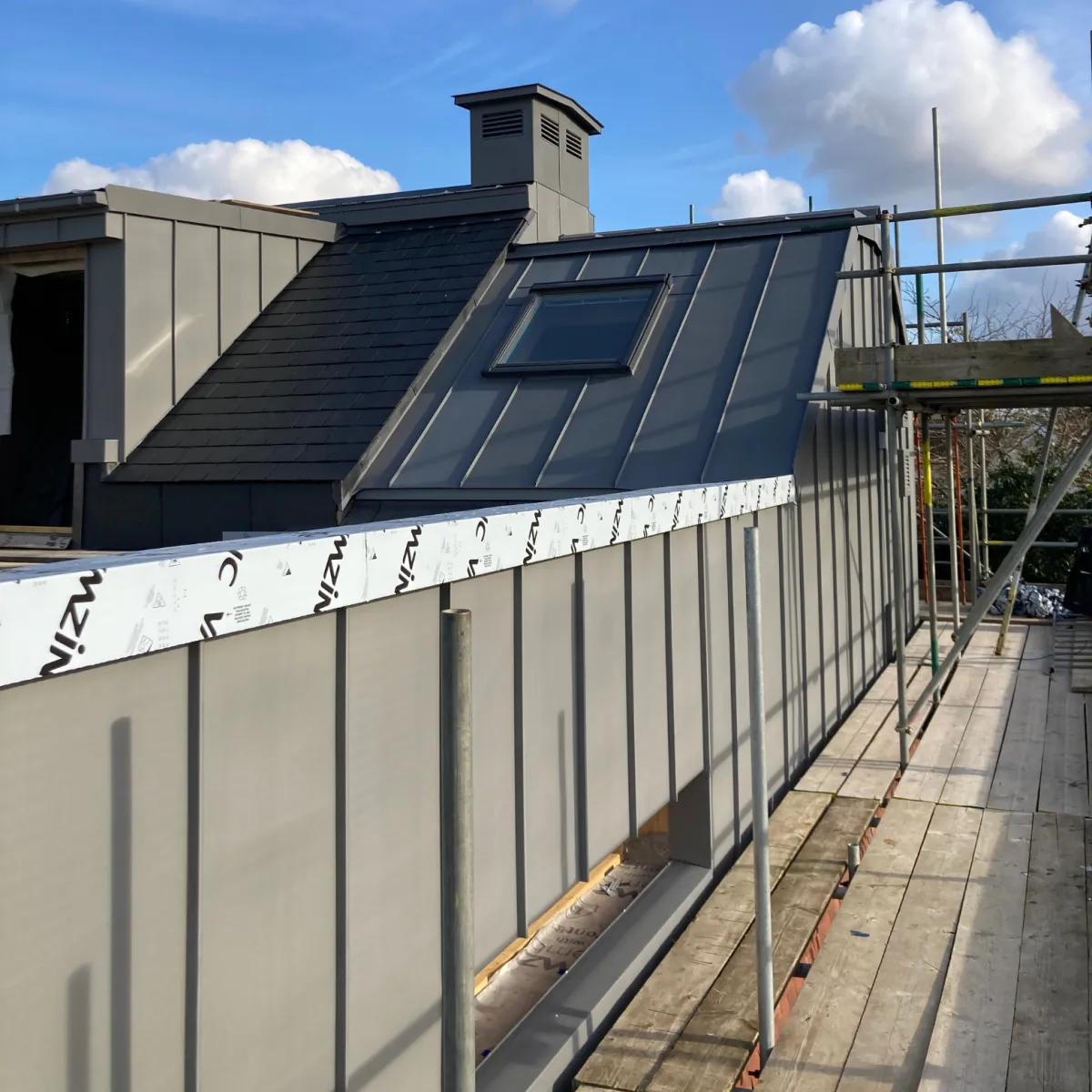
[IMAGE: completed zinc-clad elevation on a residential extension]
Talk to a specialist before you decide
Most zinc cladding "problems" we get called to inspect are specification or installation issues — not material failures. At Dr Master Craft we design, fabricate and install zinc cladding in standing seam, flatlock and bespoke formats using VMZINC systems, with fully ventilated build-ups and detailing designed around the drawbacks listed in this article.
Send us your drawings or photos and we'll give you a straight answer on whether zinc suits your project — and a considered quotation, usually within 48 hours.
→ Explore our zinc roofing & cladding service→ Request your free quote — 48-hour turnaround
Areas we cover
We install zinc, copper, aluminium and coated-steel cladding across London and the South East, including:
London — North London, Central and Prime Central London (Belgravia, Mayfair), South East London and all surrounding boroughs
Essex — including Chelmsford, Epping and the London fringe
Hertfordshire — St Albans, Hertford, Watford and surrounds
Surrey — Guildford, Woking, Epsom, Reigate
Kent — Sevenoaks, Tunbridge Wells, Maidstone, Canterbury
Oxfordshire — Oxford and the county
Cambridge, Brighton and the wider South East, with projects also undertaken further afield (including Exeter and the South West) for the right brief
Not sure if we cover you? Ask us — for distinctive projects we regularly travel beyond our core area.
Frequently asked questions
What is the main disadvantage of zinc cladding?
The upfront cost (£250–£350 per m² installed in the UK) and its dependence on specialist installation. The most common real-world failure — hidden underside corrosion from trapped moisture — is caused by incorrect build-ups, not by the material itself.
Is zinc cladding high maintenance?
No — it's one of the lowest-maintenance claddings available. There's no painting, sealing or recoating; gutters and an occasional visual check are the whole maintenance list. The trade-off is that the correct build-up must be right on day one, because zinc is unforgiving of installation shortcuts.
Does zinc cladding corrode or rust?
Zinc doesn't rust (that's iron oxide), and its surface corrosion is extremely slow — about 2 microns per year against a 700-micron sheet, protected by a self-healing patina. It can, however, suffer galvanic corrosion from contact with copper or incompatible metals, and underside corrosion if moisture is trapped behind the panels.
How long does zinc cladding take to weather?
Natural zinc takes roughly 2–5 years to develop its full matt grey patina, and can look patchy or streaked across a facade during that period. Pre-weathered finishes (QUARTZ, ANTHRA) and Pigmento colours give a uniform appearance from day one at a modest premium.
Does zinc cladding stain other materials?
Yes, during early weathering. Rainwater runoff carries zinc salts that can leave grey-white stains on pale render, masonry and paving below. Correct drip details, sills and guttering designed at specification stage prevent it.
Is zinc cladding noisy?
It can produce light clicking or ticking as panels expand and contract with temperature changes — normal and harmless, but noticeable to some people on bedroom elevations. Correct clip detailing minimises it.
Is zinc cladding better than aluminium?
On longevity and whole-life cost, yes: zinc lasts 80–100+ years versus 40–60 for aluminium, at a comparable installed price. Aluminium wins on impact resistance, exact colour matching (any RAL) and lighter weight. The right answer depends on the project's priorities.
Is zinc cladding worth the money?
For long-term owners, usually yes — around £3 per m² per year over its lifespan is cheaper than repeatedly replacing budget claddings. For short hold periods or tight capital budgets, the premium is hard to recover and a coated steel or fibre cement system may be the honest recommendation.
References and further reading
Cost and market data:
Checkatrade, "House Cladding Cost UK: 2026 Price Guide" (August 2026) — zinc cladding £300–£350/m² installed, average £325/m²; comparator figures for aluminium, timber, uPVC and fibre cement.
Architecture Today / VMZINC UK, "Zinc roofing and cladding: specification to installation" — system types; requirement for competent specialist contractors (VMZINC@WORK trained installers).
Material behaviour and durability research referenced:
BRE Environmental Product Declaration for zinc — 100-year reference service life.
CIB W080 / RILEM service-life research — zinc atmospheric corrosion ~2 µm/yr in typical UK conditions, rising to 5–6 µm/yr in severe marine/industrial environments; trapped underside moisture as the principal premature failure mode; patina formation timescales.
VMZINC / Rheinzink technical literature — galvanic compatibility tables (copper, acidic timbers), thermal expansion coefficients, runoff staining guidance, and pre-weathered finish specifications.
Page, I.C. (1997). "Life Cycle Costs of Claddings." BRANZ Study Report SR75 — whole-life cost methodology.
Installed-cost figures are indicative 2026 UK ranges for bespoke hard-metal work; your project quotation is the only number that counts.