Zinc vs Copper vs Aluminium vs GreenCoat — Which Metal? (2026)
Zinc vs Copper vs Aluminium vs GreenCoat: Which Metal Should Your Project Use?
The short answer: zinc is the default for contemporary UK roofing and cladding — mid-cost, self-healing, planner-friendly. Copper earns its premium where the patina journey and heritage weight justify it. Aluminium (PREFA) wins on colour stability, weight and long coating guarantees. GreenCoat PLX steel delivers the standing-seam look at the keenest cost. None is “best” — the right choice depends on the building, the budget, the planning context and the maintenance appetite.
These metals are not interchangeable. Choose for the building, the budget and the maintenance appetite — then hire someone who has installed all four.
We supply and fit all four systems, so we have no shelf to clear. This is the comparison we give architects and homeowners at survey: the honest differences, the install reality nobody puts in the brochure, and when each metal is simply the wrong answer.
The 20-second comparison
Zinc | Copper | Aluminium (PREFA) | GreenCoat PLX steel | |
Lifespan | 60–100 years | 100+ years | 40–60+ years (coating-dependent) | 40–60 years |
Look over 20 years | Bright silver → soft mid-grey patina | Bright → brown → green patina | Colour stable; chosen RAL shade holds | Colour stable; chosen shade holds |
Installed cost | Baseline — mid of the hard-metal range | Premium above zinc | Comparable with zinc | Below zinc — the value tier |
Maintenance | Very low; self-healing patina | Very low; patina is the protection | Low; inspect coating, clean periodically | Low; inspect coating at cut edges |
Runoff behaviour | Safe over most materials; keep copper away from it | Runoff attacks zinc and aluminium — detail separation | Keep away from copper runoff | Keep away from copper runoff |
Heritage acceptance | Excellent — reads as lead/slate to planners | Excellent — centuries of precedent | Case-by-case; profile and colour dependent | Good in the right colour and profile |
Best use-case | Extensions, dormers, whole roofs, façades | Feature roofs, heritage, statement façades | Large roofs, colour-critical schemes, coastal | Budget-conscious standing seam, rural and agricultural conversions |
For real numbers rather than relative bands, see our 2026 cost guide (Post 02 in this series) — installed ranges by system, signed off and kept current. The rest of this post is about the differences that tables flatten.
Zinc: the default — and when it is the wrong answer
Zinc earns its default status honestly. It is light, workable into complex geometry, self-healing through its patina, and mid-grey weathered zinc is the single easiest metal to get past a conservation officer. For a North London extension, dormer or whole re-roof, it is where the conversation starts — our zinc roofing and cladding page shows the systems and finishes in place.
But zinc is not universal. It is the wrong answer on very low pitches below the system's minimum fall, on buildings where a specific bold colour is non-negotiable (the palette is greys plus the pigmented ranges, not the full RAL chart), in aggressive coastal or industrial atmospheres without the right grade and detailing, and where the budget genuinely cannot stretch past coated steel — a thin zinc job is worse than a good PLX one. We set out the full honest list in our zinc disadvantages article, and we would rather talk you out of zinc at survey than into a callback in year three.
Copper: when it earns its premium
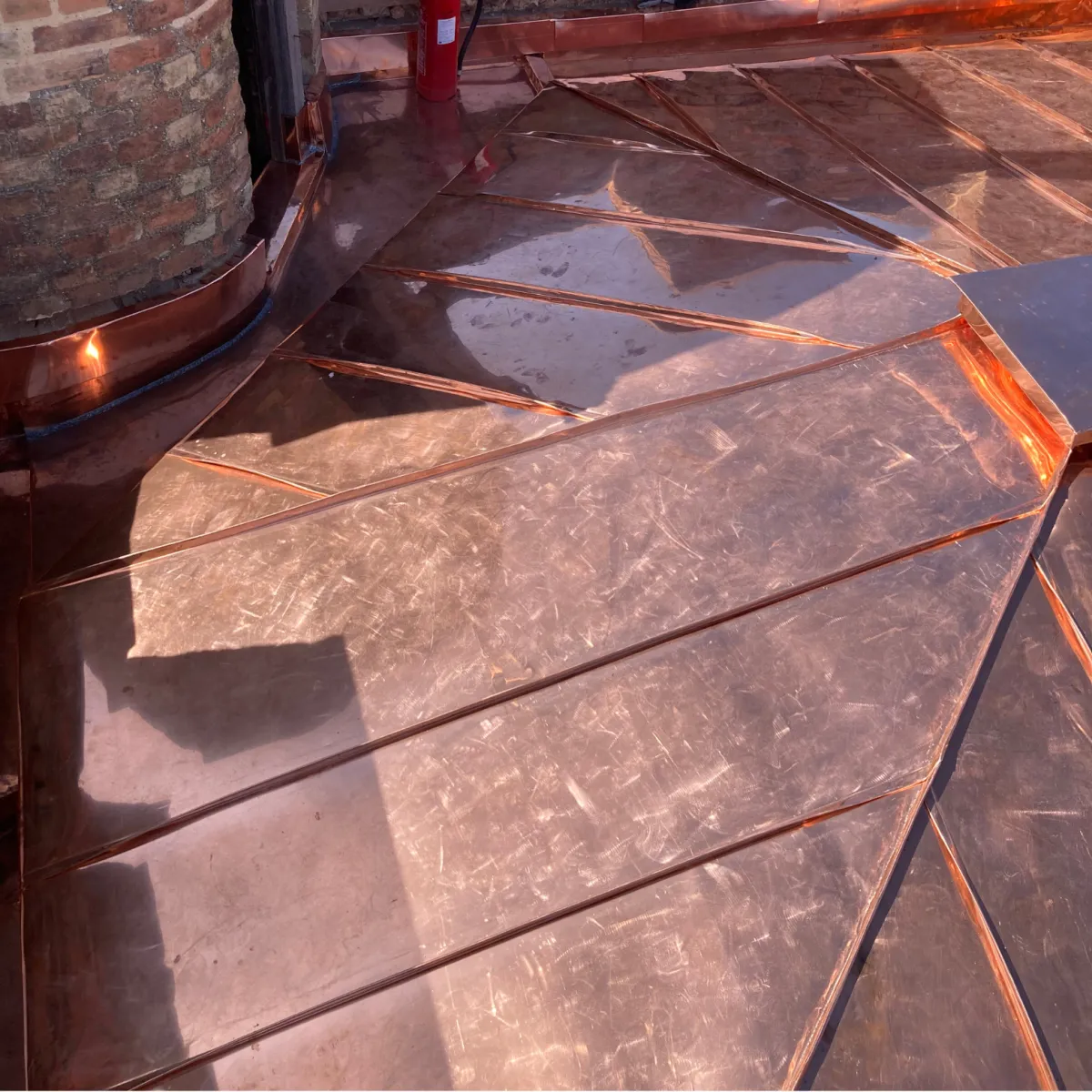
Copper costs more than zinc and is worth it in two situations. First, heritage: on period and listed buildings copper carries centuries of precedent, and planners and conservation officers know it. Second, intent: when the client actively wants the colour journey — bright to russet brown to green — as part of the architecture, not a side effect of it.
At Church Cottage, Southill Park (2025), we supplied and installed bespoke copper precisely because the building wanted a material with that weight and warmth. Copper also outlasts everything else on this page — 100 years is a conservative figure — and it demands the best detailing discipline: thermal movement is significant, and its runoff must be kept off zinc, aluminium and coated steel below. Specify copper with a contractor who enjoys those rules, not one who discovers them on site.
Aluminium (PREFA): the colour-stable lightweight
Aluminium is the lightest metal on this page and the most colour-flexible: powder-coated or coil-coated in virtually any RAL shade, with premium systems holding colour and coating guarantees of up to 40 years. It does not patinate — the shade you choose is the shade you keep — which is either the point or the drawback, depending on the architecture.
It comes into its own on larger roofs and commercial envelopes where weight, repetition and colour consistency across plots matter. On the Travelodge Twickenham project (2025) we installed aluminium cladding for exactly those reasons — a commercial envelope where a stable, warranted finish across a big area beat a living metal. Watch the detailing: aluminium moves with temperature more than zinc, and it needs the same separation discipline from copper runoff.
GreenCoat PLX steel: the grown-up value engineering
GreenCoat PLX is colour-coated Swedish steel with a coating made using rapeseed oil in place of a substantial portion of conventional fossil oils. It folds cleanly for standing seam, holds its colour, and lands meaningfully below zinc on installed cost — which makes it the honest answer when the budget is real but the client still wants a proper hard-metal roof rather than a panel product.
At Blackett Ord Court, Royston (2023), we installed GreenCoat PLX standing seam as exactly that move — the standing-seam aesthetic and longevity at a number the project could carry. The watch-outs are cut-edge discipline and keeping it away from copper runoff; beyond that, for rural plots, agricultural-to-residential conversions and budget-aware extensions, PLX is often the right metal, full stop.
The rules that apply whichever metal you choose
Thermal movement. Every metal on this page expands and contracts; long bays need the right seam and clip strategy. This is engineered at survey, not improvised on the scaffold.
Runoff and galvanic compatibility. Copper water attacking zinc, aluminium or coated steel below it is the single most common mixed-metal failure we inspect. One drawing note — separation membrane, drip detail, rainwater routing — prevents it; one omission guarantees it.
Noise. Rain on any metal roof is audible on a poorly built-up deck and a non-issue on a properly insulated, ventilated build-up. If a neighbour's metal extension “rattles”, the build-up is the culprit, not the metal.
Planning on period streets. Mid-grey zinc and copper are routinely accepted in conservation areas because they echo lead and precedent. Bold RAL colours on aluminium or steel need a stronger argument — winnable, but choose the battle with the officer in mind.
How this goes wrong on site
The failures we are called to inspect almost never come from the metal. They come from the interfaces: copper valley discharge streaking and corroding a zinc dormer cheek below; a mixed-metal roof where nobody wrote the separation note; long aluminium bays fixed rigid, oil-canning by the first summer; coated steel cut on site with the wrong disc, rusting from the edges inward; a bold-colour façade approved on a screen swatch that reads three shades brighter in daylight.
Every one of those was decided before installation — in the metal choice, the drawing set or the sample review. That is why we treat “which metal” as a surveying conversation, not a catalogue page.
If you are choosing — pick your seat
If you are an architect
Write the metal and the finish range into the spec by manufacturer and system, and add the separation and movement notes to the drawings — the tender returns will get measurably cleaner. Send the elevation and we will mark up which metal we would put where, and what the spec needs to say for the warranty to hold.
If you are a homeowner
Ignore anyone who tells you one metal is simply “the best”. The right question is which metal suits your house, your planner and your maintenance appetite — and the honest answer sometimes costs less than the one you arrived with. Order a sample box and look at real zinc, copper, PREFA and PLX in your own daylight before deciding.
If you are a developer
Think in terms of repeatability: colour-stable metals (PREFA, PLX) keep plots consistent across a phased scheme, while living metals vary batch to batch and year to year. Send the roof plan and the programme and we will tell you where each metal sits on cost, lead time and snag risk.
FAQs
Which lasts longer, zinc or copper?
Copper — 100 years or more is realistic, against 60–100 for zinc. Both comfortably outlive the mortgage; copper's extra decades come at a premium and with stricter runoff rules, which is why zinc remains the default and copper the deliberate choice.
Is GreenCoat PLX as good as zinc?
Different, not worse. PLX gives you the standing-seam look, a stable colour and a 40–60-year service life at a lower installed cost. Zinc gives you a self-healing living finish, longer life and easier conservation-area acceptance. On the right building with the right budget, PLX is the correct specification.
Can you mix metals on one roof?
Yes — with discipline. Copper features above zinc or aluminium are common and handsome, but only with proper separation details and rainwater routing, because copper runoff attacks the metals below. Mixed-metal designs should be drawn, not improvised.
Which metal roof is quietest in the rain?
All four are quiet on a correctly insulated, ventilated build-up and audible on a poor one. If rain noise is a worry — a bedroom under a shallow-pitch roof, say — the answer is in the deck and insulation specification, not in swapping metals.
What is the difference between metal cladding and a coloured roof?
“Coloured roof” usually means a factory-coated metal — aluminium or coated steel — where the colour is an applied finish that stays put. Zinc and copper are living metals whose colour develops as a patina. One is a paint decision, the other is a material decision; both are legitimate, but they age very differently.
Can I change the colour of a metal roof later?
Coated metals can be refinished, at meaningful cost and with preparation caveats. Zinc and copper cannot meaningfully be recoated — you are choosing a patina journey, not a paint colour. If colour certainty matters more than the living finish, choose aluminium or PLX from the start.
Not Sure Which Metal? Send the Elevation
Send your drawings — or photos and a postcode — and we will tell you in writing, within 48 hours, which metal we would put on your building and why, with the finish range and the cost band for each option. Or book a site survey and we will bring the sample box: real zinc, copper, PREFA and GreenCoat PLX to review in your own daylight.
Prefer to read first? See our zinc roofing and cladding work, or what the GreenCoat PLX value option looks like installed. Material samples and colour boards are available with any enquiry.
Dr Mastercraft Ltd — supply and fit of zinc, copper, aluminium, steel and standing-seam roofing and cladding. Based in Enfield, working across London, Essex and the South East. Call the office to book your survey.