Why Do Copper Roofs Turn Green? Patina Explained (2026)
Why Copper Roofs Turn Green — and When to Specify That on Purpose
Copper roofs turn green because copper reacts with air and rain to grow a protective mineral skin — a patina — on its own surface. It is a chemical change, it is protection rather than decay, and in UK conditions the full journey from bright copper to green typically takes 15 to 30 years, faster on the coast and in city air. If you want the green on day one, pre-patinated copper exists and we install it. If you want the roof to earn its colour, that works too — and every stage in between looks good.
Patina is protection, not decay. A copper roof turning green is a copper roof doing its job.
This guide covers the chemistry in plain English, a realistic UK timeline (not the textbook Alpine one), when to specify pre-patinated finishes on purpose, and the runoff rule that decides whether copper was a good idea on your building at all.
Is copper turning green a physical or chemical change?
A chemical change.
The green is not paint wearing off, and it is not a coating. The copper atoms at the surface genuinely react with oxygen, moisture and trace compounds in the air to form new substances — copper oxides first, then the green copper minerals of the mature patina. The metal underneath has changed chemistry at its surface, which is what makes it a chemical change. It is also irreversible in practice: you cannot polish a patinated roof back to bright copper and expect it to stay that way, because the reaction simply starts again.
The chemistry, in plain English
Bright new copper reacts with oxygen within weeks, forming a thin dark copper-oxide layer — that is the russet, then chocolate-brown stage. Over years, that layer reacts further with rainwater, carbon dioxide and sulphur compounds in the atmosphere, slowly converting into basic copper salts — the same family of minerals you see on old church spires and the Statue of Liberty.
Here is the part that matters for your roof: that mineral skin is dense, adherent and self-repairing. Once formed, it dramatically slows any further reaction, which is why copper roofs routinely pass a century of service. The green is not the copper wearing out — it is the copper finishing its own armour. Scratch it, and the exposed spot re-patinates. There is no paint to peel because there is no paint.
The copper colour timeline in the UK
Stage | What you see | Typical UK timing |
|---|---|---|
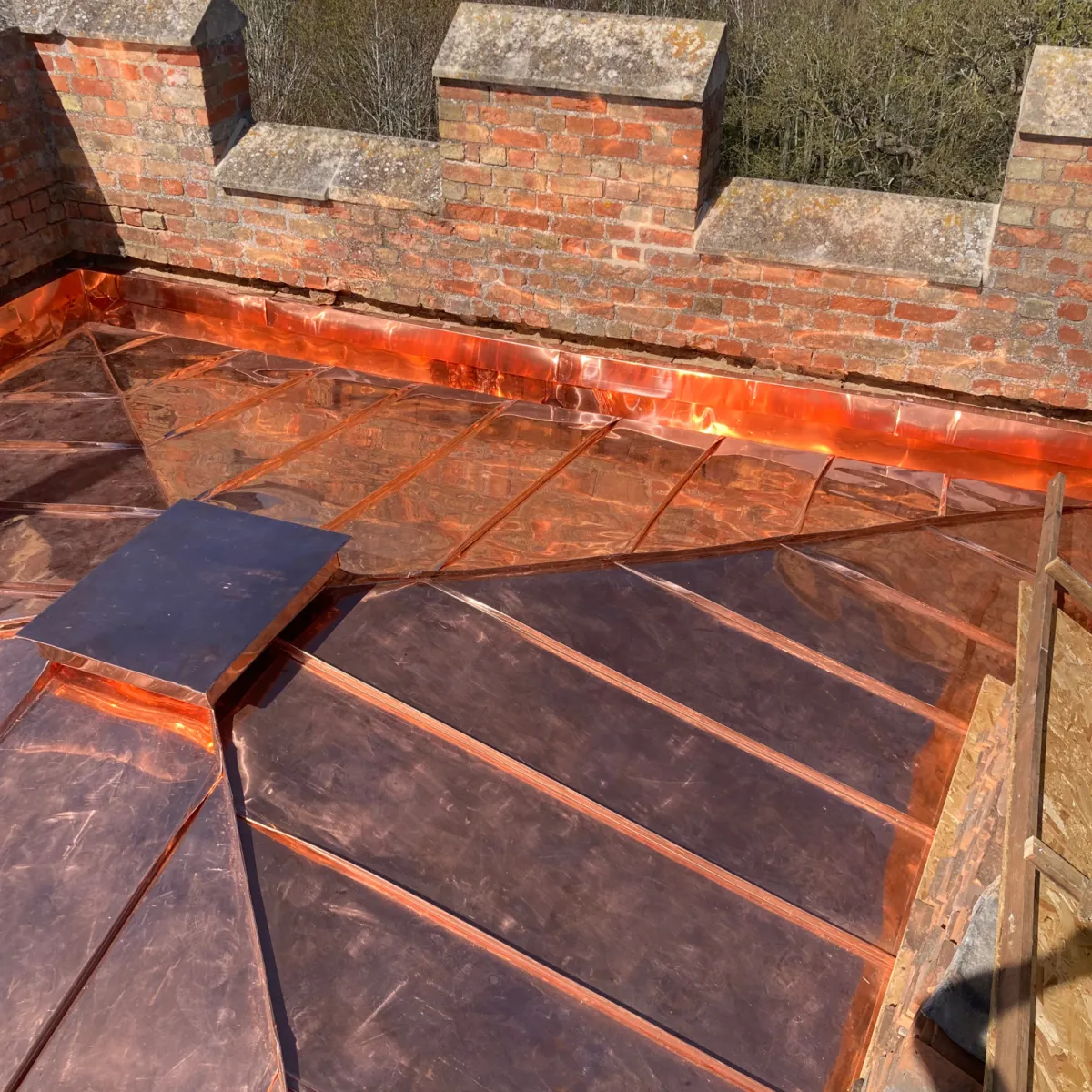
Day one | Bright salmon-pink metallic | Installation week |
Early oxidation | Dulling to russet and warm brown | First months to ~1 year |
Mature oxide | Deep chocolate brown, even and handsome | Years 1–5 |
First patina | Green/blue-green streaking on the most exposed faces | Years 5–15 |
Full patina | The familiar mineral green | Years 15–30 |
These are honest UK ranges, not brochure numbers. Sheltered elevations and rural air sit at the slow end; exposed faces, coastal salt and urban air sit at the fast end. A south-facing slope will often patinate visibly ahead of a north-facing one on the same roof — which is normal, and evens out with time.
London timing is not textbook timing
Most patina timelines quoted online come from Alpine or North American references. UK conditions — frequent light rain, mild temperatures, urban air — tend to move copper through the brown stages quickly and then take their time over the green. In London, expect a handsome brown roof for most of the first decade and visible greening on exposed faces from somewhere around years 7 to 15, with coastal Essex and Kent moving faster than a sheltered Hampstead garden.
The practical point: when you choose copper, you are choosing the brown years as much as the green ones. Clients who love the bright penny shine should know it is the shortest chapter of the story — and clients who want only the mature green should read the next section.
When to specify the green on purpose
Pre-patinated copper gives you the end state at handover. The finishes we specify by name include KME's TECU Patina (factory-developed green patina) and TECU Oxid (pre-oxidised deep brown), and Aurubis's Nordic Green and Nordic Brown ranges — real copper, patinated or oxidised under factory control so the colour is even from day one. Nordic Royal, a golden copper alloy that stays stable rather than greening, is the answer for clients who want warmth without the journey.
Pre-patinated finishes make sense on heritage work where a bright new roof would look wrong against an old building, on extensions where the copper must match an existing patinated roof, and for any client who wants the green but not the fifteen-year wait. The patina continues to mature naturally afterwards — the factory finish is a head start, not a freeze.
The runoff rule that decides whether copper was a good idea
Rainwater that has run across copper will attack zinc, aluminium and coated steel below it.
Copper wash-water carries dissolved copper compounds that are aggressively corrosive to those metals. This single rule shapes copper design: never discharge a copper valley or gutter onto a zinc dormer cheek, an aluminium window cill or a coated-steel panel. It is one of the most common expensive failures we are called to inspect — a beautiful copper roof quietly destroying the metalwork beneath it — and it is entirely preventable with drip details, separation membranes and sensible rainwater routing at the drawing stage.
It cuts both ways: copper is also why we ask what is below and beside your roof before we quote. A good copper contractor specifies the water's whole journey, not just the shiny part.
How this goes wrong on site
The copper failures we see are consistent. Copper runoff streaking and pitting the zinc cladding beneath a new valley. A homeowner sold “copper that stays bright” with a lacquer that peels in patches within two years and looks worse than any patina. Pre-patinated panels from different batches fixed side by side, reading as two different greens. Bright copper specified against a conservation officer's expectations, refused, and re-ordered pre-patinated at the client's expense.
None of these are arguments against copper. They are arguments for specifying the finish, the batching and the runoff before the order is placed — which is exactly what a survey-led quote is for.
A real example
At Church Cottage, Southill Park (2025), we supplied and installed bespoke copper on a building where a living metal was the whole point — the owners wanted the brown years and the eventual green as part of the architecture, and the detailing was designed so every drop of copper wash-water lands where it can do no harm. That is what “specifying the patina on purpose” looks like in practice: the colour journey chosen knowingly, and the water journey drawn deliberately.
If you are deciding — pick your seat
If you are a homeowner
Choose copper for the journey, not a single snapshot. If the idea of a brown roof for a decade bothers you, say so at survey — pre-patinated copper exists precisely for you. If you love the thought of the roof ageing with the house, natural copper will not disappoint; we can show you examples at two years and at fifteen so you know exactly what you are buying.
If you are an architect
Name the finish by manufacturer and range — TECU Patina, Nordic Green — rather than “copper, green”, and add the runoff note to the drawings: separation from zinc, aluminium and coated steel, and a defined discharge route. We will happily review the detail before tender; it is a five-minute check that prevents the most expensive copper failure there is.
If you are a developer
Remember that copper changes across a phased scheme — phase one will not match phase two for years. Where plot-to-plot consistency matters, pre-patinated or colour-stable metals are the safer specification, and we will tell you so even when copper would be the bigger invoice.
FAQs
Do all copper roofs turn green eventually?
Yes, if left to nature — every uncoated copper roof will patinate, because the chemistry does not negotiate. The only exceptions are copper alloys engineered to stay stable (such as Nordic Royal's golden finish) or factory-pre-oxidised finishes that hold a chosen stage for longer.
How long before a copper roof turns green in the UK?
Expect the brown stages within the first year or two, first green streaking on exposed faces around years 5 to 15, and a mature green patina somewhere between 15 and 30 years. Coastal and urban sites move faster; sheltered and rural sites slower.
Can you stop a copper roof going green?
Not honestly. Clear lacquers delay the change but peel unevenly and age worse than the patina would have. If you want a stable warm metallic colour, the right answer is a copper alloy or a different metal — not a coating fighting chemistry.
Is the green patina a problem? Should it be cleaned off?
No and no. The patina is the protective layer that gives copper its century-plus lifespan. Cleaning it off removes the protection and simply restarts the process. The only maintenance a copper roof needs is keeping gutters clear and checking flashings — the green can be left to do its job.
Do copper gutters turn green too?
Yes — copper gutters and downpipes follow the same brown-to-green journey as the roof, usually slightly faster because they stay wetter. Plan the rainwater goods as part of the same colour story, not as an afterthought.
Is pre-patinated copper real copper?
Yes — it is genuine copper sheet whose patina has been developed under factory conditions rather than on your roof. It weathers and matures further once installed, carries the same lifespan, and is the standard way to match new copper work to an existing patinated building.
Want the Green on Day One — or Want to Earn It?
Tell us which at survey and we will specify accordingly: natural copper for the journey, or a named pre-patinated finish — TECU Patina, Nordic Green — for the mature look at handover. Either way, we will show you real examples at different ages so the choice is made with your eyes open. Book a site survey or send photos and a postcode for a written view within 48 hours.
Prefer to read first? See our copper roofing and cladding work, including KME copper systems and Aurubis finishes. Samples of natural, oxidised and pre-patinated copper are available with any enquiry.
Dr Mastercraft Ltd — supply and fit of copper, zinc, aluminium, steel and standing-seam roofing and cladding. Based in Enfield, working across London, Essex and the South East. Call the office to book your survey.