Why Do Copper Roofs Turn Green?
Why Do Copper Roofs Turn Green?
The Science of Copper Patina
Copper roofs turn green because the metal reacts with oxygen, moisture, and trace compounds in the air to form a thin surface layer called a patina.
This is a chemical change, not damage: the green layer — mostly a mineral called brochantite — actually seals and protects the copper underneath, which is why copper roofs routinely last over 100 years. In the UK, the full green transformation typically takes between 5 and 30 years depending on where you live.
If you've ever admired the green domes of a cathedral or the roofline of an Edwardian townhouse, you've seen the end result of one of architecture's slowest and most beautiful chemical reactions. At Dr Master Craft, we install bespoke copper roofing and cladding across London and the South East — and "when will it go green?" is one of the first questions homeowners ask us. Here's the honest, science-backed answer.
What is copper patina, exactly?
A patina is a stable mineral layer that forms on the surface of copper as it weathers. It is not rust, and it is not decay. Where rust eats into iron and destroys it, patina forms a dense, self-adhering skin on copper that stops further corrosion almost completely.
The green colour you see on old copper roofs is mainly brochantite — a basic copper sulphate with the chemical formula Cu₄(OH)₆SO₄. In coastal areas, the patina also contains copper chlorides, and in sheltered spots you may see darker oxides instead. The exact colour of a mature roof — leaf green, blue-green, or deep bronze — is literally a chemical record of the air it has breathed.
Why do copper roofs turn green? The chemistry in three stages
Copper doesn't go from shiny to green overnight. It moves through a predictable sequence:
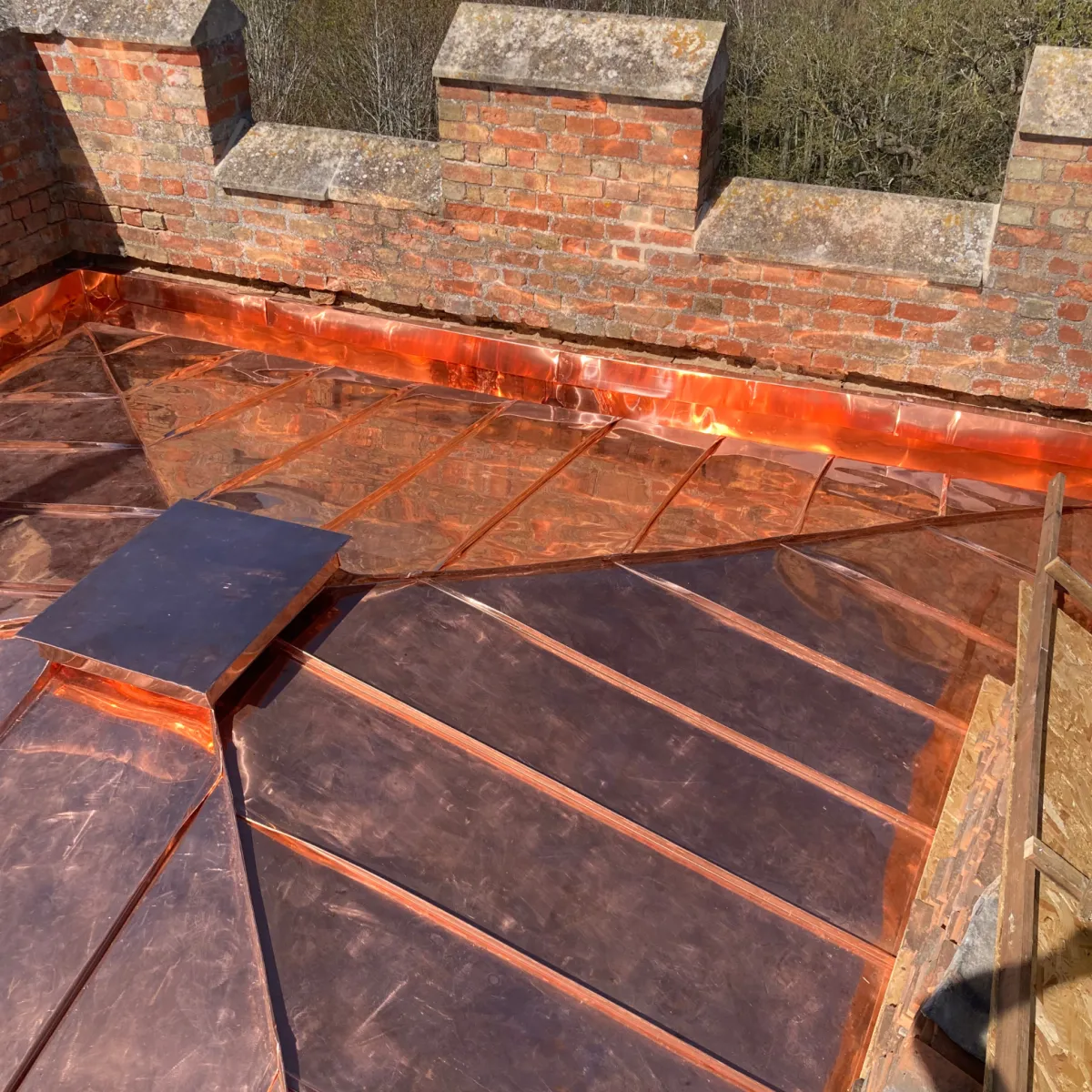
Stage 1 — Cuprite (days to months). Within days of installation, bright salmon-pink copper reacts with oxygen to form cuprite (Cu₂O), a dark reddish-brown oxide. This is why a new copper roof quickly loses its "new penny" shine and deepens to russet brown.
Stage 2 — Dark bronze (1–5 years). Continued weathering builds the oxide layer into a rich chocolate brown or dark bronze. Many London roofs sit handsomely in this stage for years, and some owners prefer it to the final green.
Stage 3 — Brochantite, the green patina (5–30 years). Slowly, the oxide layer reacts with sulphur dioxide, carbon dioxide, water and oxygen in the atmosphere to form basic copper sulphates and carbonates — brochantite chief among them. When this conversion completes, the roof takes on the unmistakable light green of the Statue of Liberty, which is simply a very large, very old copper roof.
How long before copper turns green in the UK?
Typical time to full green patina
Near heavy industry / high air pollution
5–8 years
Marine / coastal (e.g. Brighton, Kent coast)
7–9 years
Urban (most of London and the South East)
10–14 years
Rural / clean air
20–30+ years
Two practical points worth knowing:
Orientation matters. Horizontal and gently sloped surfaces patinate fastest, because rainwater sits on them longer. Vertical copper cladding and dormer cheeks can stay bronze for decades — one reason architects mix planes deliberately.
Cleaner air means slower patination. UK sulphur dioxide levels have fallen dramatically since the 1970s, so a copper roof installed today will generally green more slowly than one installed fifty years ago.
Do copper gutters and downpipes turn green too?
Yes — copper gutters, downpipes and flashings go through exactly the same chemistry. In practice they often green faster than the roof itself, because they handle concentrated water flow and stay wetter. The same applies to copper bay window roofs, canopies and weather vanes.
One design caution: run-off from unpatinated copper can leave faint green or brown streaks on porous materials like pale render or limestone. A competent installer details drip edges and clearances to prevent this — it's a craftsmanship issue, not a material flaw.
Is a copper roof turning green a physical or chemical change?
It's a chemical change. The copper atoms at the surface are converted into entirely new compounds — first copper oxide, then copper sulphates and carbonates. You cannot polish a green roof back to pink without chemically removing the patina layer, and any coating that tries to hold the shine permanently is fighting chemistry it will eventually lose.
That said, you can influence the pace:
To slow it down: clear protective lacquers and waxes delay patination, but need re-application every few years — an ongoing maintenance commitment.
To speed it up: factory pre-patinated copper delivers the green finish on day one. It's chemically similar to natural patina and is ideal when you're extending an existing green roof, or when planning policy asks for a weathered appearance from the outset.
Should you embrace the green — or resist it?
For most buildings, our advice is to embrace it. Here's why:
Protection. A mature patina is the reason copper roofs last 70–100+ years with almost no maintenance. The green is the protection.
Value. Patinated copper is a hallmark of high-end architecture. Belgravia and Mayfair planners actively favour it on heritage and premium schemes.
Sustainability. Copper is fully recyclable without loss of quality, and a century-long service life means near-zero replacement waste.
The case for resisting it is mostly aesthetic: if your design concept depends on the warm bronze stage, pre-weathered or lacquered finishes can hold it — just go in with your eyes open about the maintenance.
Planning a copper roof? Get the detailing right from day one
A copper roof is a 100-year decision, and how it's installed determines how evenly and beautifully it patinates. At Dr Master Craft we fabricate and install traditional standing seam copper roofing, cladding and guttering across London, Essex and the South East — including pre-patinated systems where the brief calls for instant green.
Explre our Copper Roofing service
Frequently asked questions
Why do copper roofs turn green?Copper reacts with oxygen, moisture and trace sulphur compounds in the air, forming a protective mineral layer called a patina. The green colour comes mainly from brochantite, a basic copper sulphate. It's a natural chemical process that protects the metal rather than damaging it.
How long does it take a copper roof to turn green?In the UK, typically 10–14 years in urban areas, 7–9 years on the coast, and 20–30 years or more in clean rural air. Vertical cladding greens much more slowly than sloped roofing because rain runs off it faster.
Is the green patina on copper a sign of damage?No — the opposite. The patina is a dense, self-healing barrier that prevents further corrosion. It's the main reason copper roofs routinely last over a century.
Can I keep my copper roof shiny and new-looking?Only with clear lacquers or waxes, reapplied every few years. Natural patination can't be stopped permanently by coatings. If you want a permanent bright finish, copper is the wrong material — consider a coated steel such as GreenCoat instead.
Can I get a green copper roof without waiting 20 years?Yes. Pre-patinated copper is factory-treated to deliver the green finish immediately, using the same base chemistry as natural patina. It's commonly used for extensions to existing patinated roofs.
Do copper gutters turn green as well?Yes — gutters, downpipes and flashings often patinate faster than roofs because they stay wetter. Good detailing prevents copper run-off from staining pale render or stonework below.
Is copper turning green a physical or chemical change?A chemical change. Surface copper atoms are converted into new mineral compounds (oxides, then sulphates and carbonates), which is why the process can't simply be polished away.