Do Roofers Do Cladding? Who Installs Metal Cladding | Dr Master Craft
Do Roofers Do Cladding? Who Actually Installs Metal Wall Cladding in the UK
Yes — many roofers install cladding, and for metal wall cladding a specialist hard-metal roofing contractor is usually exactly the right firm to call. Standing seam zinc, copper, aluminium and coated-steel cladding uses the same materials, the same tools and the same folded-seam techniques as metal roofing, so the trade bodies that govern this work (such as the FTMRC) cover "roofing and cladding" as one discipline. What a general tile-and-felt roofer won't usually do is bespoke metal cladding — that's a craft specialism.
If you're planning a zinc or copper feature wall, a fully clad extension, or a roof that flows down into the walls, here's how to work out who should do the job, how to check they're qualified, and the questions that separate the specialists from the chancers.
The short answer by material
Cladding type | Who typically installs it |
|---|---|
Zinc, copper, aluminium or steel standing seam / flatlock | Specialist hard-metal roofing & cladding contractors (FTMRC-type firms) |
Composite / insulated panels (e.g. Kingspan-type systems) | Industrial roofing & cladding contractors |
Fibre cement boards (Cedral-type) | General roofers, carpenters, façade contractors |
Timber cladding | Carpenters, general builders |
uPVC cladding | General roofers / fascia-soffit installers |
Render, brick slip, stone | Renderers, bricklayers, specialist façade firms |
The pattern: if the cladding is sheet metal formed by hand — folded seams, flatlock panels, bespoke flashings — it belongs to the metal roofing trade. If it's boards, planks or panels fixed with screws, it's usually a carpentry or general-building job. The roof-to-wall crossover is real, but only inside the metal specialism.
Why metal roofers are the natural cladding installers
Standing seam metalwork doesn't recognise a hard boundary between "roof" and "wall" — and neither do the people who install it.
Same materials, same skills. A zinc standing seam wall uses identical coil, identical seaming tools and identical folding techniques to a zinc standing seam roof. Flatlock panels, angle seam and shingle systems all appear on both.
The trade body treats them as one craft. The Federation of Traditional Metal Roofing Contractors (FTMRC) — the UK body that vets hard-metal specialists — publishes its technical guide for "the design, specification and installation of traditional metal roofing and cladding," and its member firms routinely advertise both.
The buildings demand it. Contemporary architecture loves the "wrap" detail — one continuous metal envelope from ridge to wall to parapet. That detail only works when one contractor, one material and one pair of hands runs the whole envelope. Split it between a roofer and a separate cladder and you get a junction detail nobody wants to guarantee.
The physics agrees. Peer-reviewed corrosion research on architectural copper and zinc (Odnevall Wallinder, Leygraf and colleagues) shows vertical metal surfaces actually weather better than roofs — walls shed water faster, stay drier and corrode less. Metal on walls isn't an experiment; it's arguably the material's best-performing position.

do roofers do cladding supporting
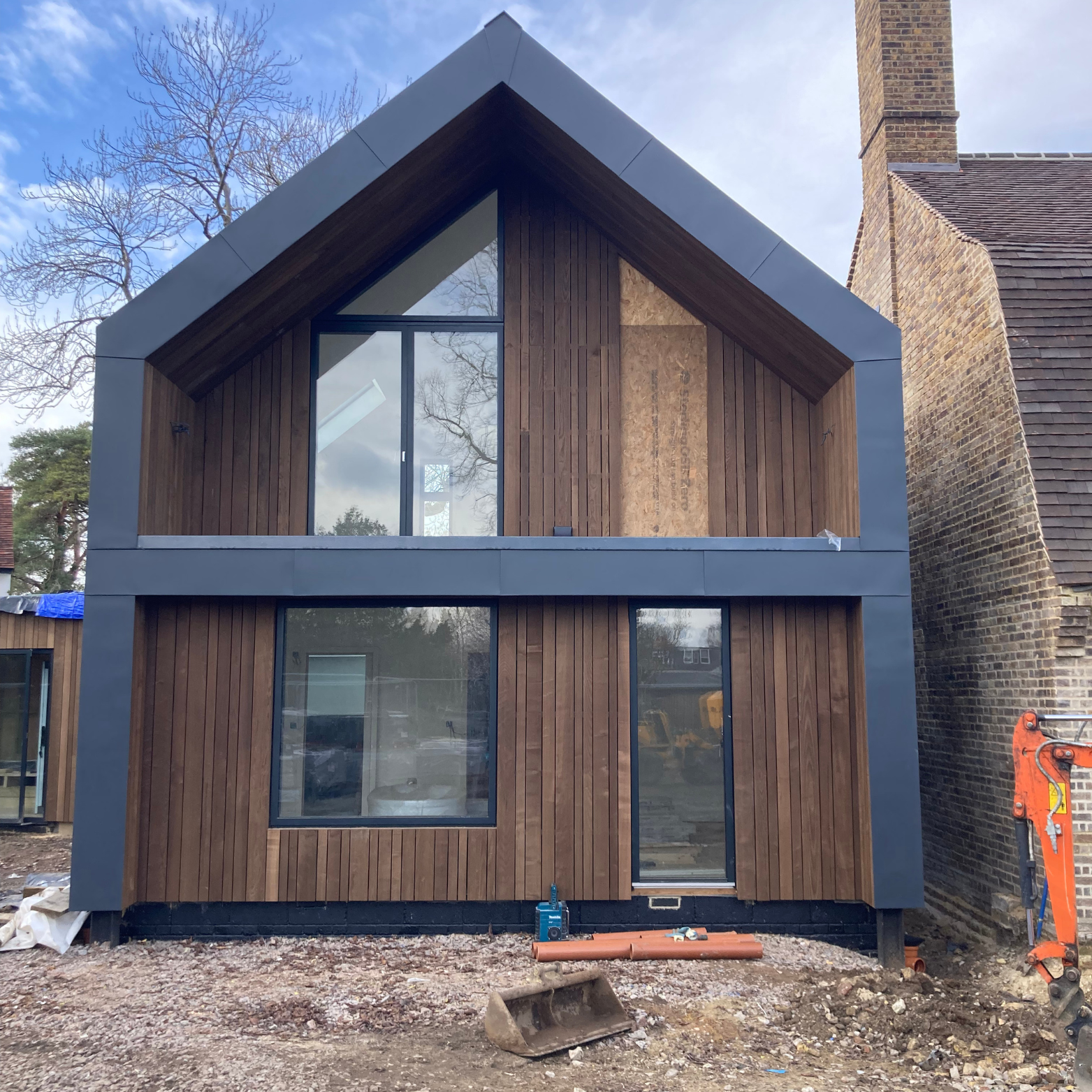
[IMAGE: standing seam roof flowing continuously into wall cladding on an extension]
When a general roofer is NOT the right choice
Here's the part that saves you money. A competent tile, slate or felt roofer is a skilled tradesperson — but metal cladding fails differently, and the failures are expensive:
Trapped moisture. Metal cladding needs a ventilated cavity and breathable membrane behind it. Get the build-up wrong and condensation corrodes the panels from behind — invisibly, until it fails. This is the single most common cause of premature metal roof and cladding failure, and it's an installation error, not a material one.
Thermal movement. Copper and zinc expand and contract far more than tiles or felt. Fixed incorrectly — no sliding clips, wrong seam heights, over-tightened fixings — panels oil-can, seams open, and fixings tear out.
Material compatibility. Copper run-off onto zinc causes galvanic corrosion; certain treated timbers and acidic run-off attack both. The compatibility rules are second nature to a hard-metal specialist and unknown to most generalists.
The finish. Metal cladding is architecture, not just weatherproofing. Panel widths, seam alignment with window heads, corner details — a specialist sets these out before ordering material. A generalist discovers them on the scaffold.
The tell-tale sign you're talking to the wrong firm: they quote metal cladding by the day rather than from a drawn panel layout.
How to check a roofing & cladding contractor's credentials
Before anyone prices your project, run this checklist:
FTMRC membership — the specific badge for zinc/copper/hard-metal work. Membership involves vetting, site inspections and technical assessment, not just a subscription.
NFRC membership — the UK's largest roofing trade body; vets technical competence, insurance and financial standing. Many roofing & cladding contractors hold both.
Manufacturer approval — VMZINC, elZinc, Rheinzink and Prefa all run approved-installer schemes with training requirements and, often, extended material warranties. Ask which systems they're certified for.
Insurance that names the work — public liability at £5m+ that specifically covers roofing and cladding at height, not a generic builder's policy.
Photographs of completed cladding — not just roofs. Ask to see wall panels, corners, window reveals and a project at least two years old.
A written build-up specification — substrate, membrane, ventilation, clips and seam heights stated in the quote. If the quote says "supply and fit zinc cladding, £X" with nothing underneath it, that's your answer.
What does metal cladding cost to have installed?
Installed by a specialist, typical 2026 UK figures run roughly:
Zinc standing seam cladding: £300–£350 per m² installed
Copper cladding: £300–£450 per m² installed — we break down exactly why in how expensive is copper cladding
Aluminium cladding panels: £200–£230 per m² installed
Scaffolding is usually separate: £600–£1,200 for a single-storey elevation, £900–£1,800 for two storeys
If a general builder quotes dramatically below these bands for "metal cladding," ask what material thickness, build-up and fixing system is included before celebrating. Finish options across all four metals are covered in our metal cladding colours guide.
[IMAGE: flatlock zinc wall cladding detail around a window reveal]
One contractor or two? The roof-and-wall question
If your project involves both a metal roof and metal walls, use one specialist contractor for both, and you'll get:
A single continuous weathering detail at the roof-wall junction — the most leak-prone point on any clad building
Matching material from the same coil batch (colour consistency matters, especially with zinc and pre-weathered finishes)
One warranty, one point of responsibility, one scaffold period
Lower total cost than mobilising two trades
Splitting roof and walls between contractors saves nothing and creates a seam — literally — that each firm can blame on the other.
Talk to a specialist
At Dr Master Craft, roofing and cladding are the same job to us. We design, fabricate and install standing seam and flatlock systems in zinc, copper, aluminium and coated steel — roofs, walls, dormers, fascias and the continuous wrap-around envelopes that join them — with fully ventilated, breathable build-ups as standard.
Send us your drawings or a few photos and we'll tell you honestly what the project needs and what it should cost — usually within 48 hours.
Areas we cover
We install metal roofing and cladding across London and the South East, including:
London — North London, Central and Prime Central London (Belgravia, Mayfair), South East London and all surrounding boroughs
Essex — including Chelmsford, Epping and the London fringe
Hertfordshire — St Albans, Hertford, Watford and surrounds
Surrey — Guildford, Woking, Epsom, Reigate
Kent — Sevenoaks, Tunbridge Wells, Maidstone, Canterbury
Oxfordshire — Oxford and the county
Cambridge, Brighton and the wider South East, with projects also undertaken further afield (including Exeter and the South West) for the right brief
Not sure if we cover you? Ask us — for distinctive projects we regularly travel beyond our core area.
Frequently asked questions
Do roofers install cladding?
Many do. For metal cladding — zinc, copper, aluminium or coated steel in standing seam or flatlock systems — specialist hard-metal roofing contractors are the correct trade, since the materials and techniques are identical to metal roofing. Timber, uPVC and fibre-cement cladding are more often fitted by carpenters or general builders.
Can a normal roofer install zinc or copper cladding?
Usually not well. Hard-metal cladding requires specialist seaming tools, training in thermal-movement detailing, ventilated build-ups and material compatibility rules. A tile or felt roofer without metalwork experience is a common source of premature cladding failure.
Who should install metal wall cladding in the UK?
A specialist metal roofing and cladding contractor — ideally an FTMRC member with manufacturer approval for the system being installed (VMZINC, elZinc, Rheinzink, Prefa etc.), £5m+ public liability insurance covering cladding at height, and photographed completed wall projects.
Is metal cladding more expensive to install than a metal roof?
Often slightly cheaper per square metre, actually — vertical surfaces are faster to work on than pitched roofs, and research shows walls shed water better and corrode less. Costs are driven more by material choice, panel format, access and detailing than by whether the surface is a roof or a wall.
Should the same contractor do my metal roof and metal cladding?
Yes. One contractor means a continuous, properly detailed roof-to-wall junction, colour-consistent material from the same batch, one scaffold period and a single warranty with no split responsibility.
What credentials should a metal cladding installer have?
FTMRC membership for hard-metal work, NFRC membership as a broader roofing credential, manufacturer-approved installer status for the specified system, insurance that explicitly covers roofing and cladding, and a written build-up specification in the quotation.
Do I need planning permission for metal cladding?
Often not for like-for-like re-cladding of a house, but changes of material on a dwelling can require consent — and conservation areas, listed buildings and flats have stricter rules. A specialist contractor will flag this at survey stage; always check with your local planning authority before committing.
How long does metal cladding last once installed?
Correctly installed zinc lasts 80–100+ years and copper 60–120+ years, with vertical cladding often outlasting roofs because walls stay drier. Coated steel typically carries 40–50 year guarantees. In every case, lifespan depends far more on the installer's build-up and detailing than on the metal itself.
References and further reading
Industry bodies and standards:
FTMRC (Federation of Traditional Metal Roofing Contractors), ftmrc.co.uk — technical guide covering "the design, specification and installation of traditional metal roofing and cladding"; member vetting and inspection process.
NFRC (National Federation of Roofing Contractors) — UK roofing trade body; member vetting for technical competence, insurance and financial standing; membership open to roofing & cladding contractors.
VMZINC, elZinc, Rheinzink, Prefa approved-installer schemes — manufacturer training, vetting and extended material warranties for certified installers.
Technical research referenced:
Hedberg, Y.S., Goidanich, S. et al. "Critical Review: Copper Runoff from Outdoor Copper Surfaces" (KTH Royal Institute of Technology / Politecnico di Milano) — vertical copper facades corrode significantly less than horizontal surfaces; corrosion rates decrease as protective patina forms.
Odnevall, I. et al. (2025). "Patina Formation and Aesthetic Durability of Architectural Copper and Copper Alloys in the Marine–Desert Environment of Dubai." Corrosion and Materials Degradation, 6(4), 51 (MDPI).
CIB W080 / RILEM service-life research — copper roof service life estimates of 60–120 years; underside corrosion from trapped moisture as the principal premature failure mode for sheet metal.
Cost data:
Checkatrade, "House Cladding Cost UK: 2026 Price Guide" — installed cost benchmarks by material.